

Like Taking Candy from a Baby
When beauty and barber culture gets studied, borrowed, repackaged, and monetized by people who already had a lane. By Ladosha Wright

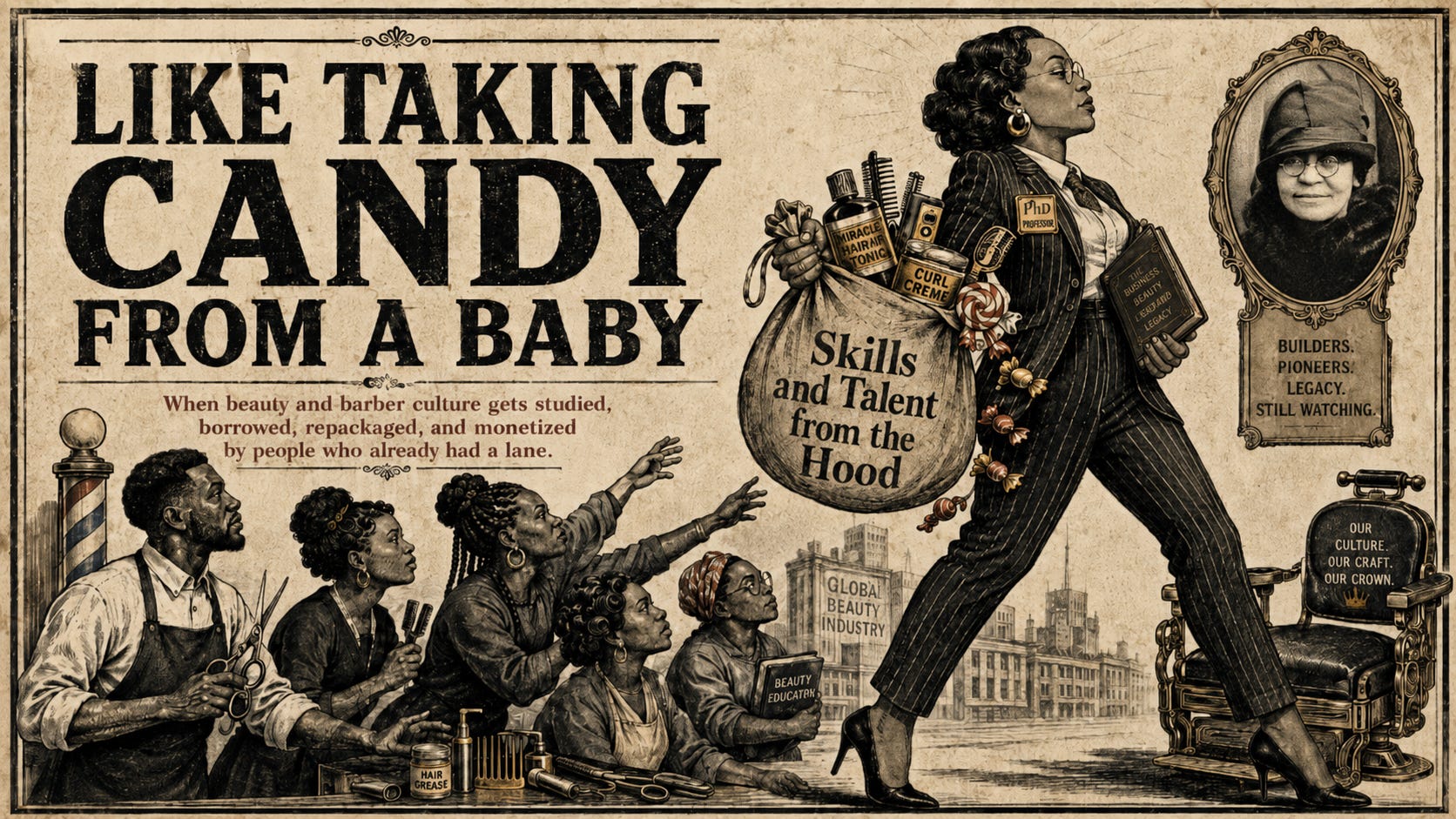
In 1904, two major things were unfolding in America.
One was the St. Louis World’s Fair, where America put its imagination, industry, race politics, spectacle, commerce, and exclusion on full display. The other was baseball, where the New York Giants were making their mark in the National League.
At first glance, the New York Giants and an emerging African American female entrepreneur may seem to have had nothing in common.
But they did; winning!
The Giants were winning on the field. Annie Turnbo Malone was winning in the beauty business. The difference is that one victory came with ease, applause, access, and a cheering public. The other had to be carved out by a Black woman in a country that denied her the very doors she still found a way to walk through.
That is why the phrase “like taking candy from a baby” sits so heavy with me.
Annie Turnbo Malone moved her operations to St. Louis at a time when the city was booming around the 1904 World’s Fair. While Black people were denied full access to many income-earning opportunities connected to that grand American spectacle, Mrs. Malone did not sit around waiting for permission. She built a marketing plan. She sold to the masses. She trained women. She expanded her business. She turned Black hair care into a professional, educational, and economic system.
The New York Giants could win a game. Annie Turnbo Malone had to win against America. And she did.
That is the part I keep coming back to when I look at today’s beauty and barber industry. We come from a tradition of beauty culturists, cosmetologists, barbers, manufacturers, educators, agents, inventors, and community builders. We come from people who did not just “do hair.” They built institutions, created jobs, trained professionals, manufactured products, opened schools, developed systems, and proved that Black hair was not a side hustle. It was an industry.
Yet today, you would be hard-pressed to find Annie Turnbo Malone’s picture hanging in many salons owned by the very people who benefit from the world she helped build. You would be hard-pressed to hear her name come out of the mouths of many self-made millionaires in beauty, even though they are sitting in an industry where her blueprint made their possibilities possible.
Instead, what we see too often is the other thing.
People taking candy from babies.
And I mean that in full E.F.F.E.C.T., boyeeeee, as Flavor Flav would say.
The “babies” are not helpless because they lack talent. Let’s not get that twisted. The babies in this case are the working hairstylists, barbers, braiders, nail techs, instructors, salon owners, school owners, and beauty professionals who are rich in knowledge but poor in access. They have the skill. They have the stories. They have the receipts. They have the lived experience.
What they often do not have is the platform, grant language, academic title, institutional backing, media connection, or policy access to protect what they know from being extracted.
That is where the encroachment comes in.
Scholars, researchers, consultants, nonprofit professionals, policy people, celebrity hairstylists, elite beauty insiders, and other well-paid professionals already have lanes to work from. They already have institutions that recognize them. They already have salaries, titles, networks, fellowships, conferences, journals, boards, and stages.
Yet some of them still find their way into the beauty and barber industry, pick up the language, borrow the culture, extract the stories, package the knowledge, and walk away with the credit, check, invitation, headline, grant, or title.
Meanwhile, the people who lived it, built it, paid booth rent through it, swept hair through it, trained students through it, raised children through it, opened shops through it, and kept the culture alive through it are left standing there like, “Did they just take our candy?”
Yes, yes, they did.
And the worst part is how easy it looks when nobody calls it out.
This is not about being against education. I love education. This is not about being against scholarship. We need research. This is not about being against policy. We need policy. This is not even about being against celebrity hairstylists or elite professionals. I enjoy and respect many of them.
But there is a difference between studying an industry and extracting from it. There is a difference between documenting a culture and using that culture to elevate yourself while the people inside that culture remain invisible. There is a difference between partnership and possession.
If you come into the beauty and barber industry with a title, a grant, a camera crew, a university department, a nonprofit initiative, or a celebrity platform, and you leave with more recognition than the people who gave you the knowledge, that is not support. That is taking candy from a baby.
If you build a report, article, class, documentary, curriculum, policy conversation, or “thought leadership” platform from the lived experience of beauty and barber professionals but fail to center them, credit them, pay them, or bring them into the room, that is not advocacy. That is taking candy from a baby.
And if you are a millionaire cosmetologist, celebrity hairstylist, platformed professional, or industry darling sitting on a throne built from Black beauty culture, yet all you give back to the industry is interviews, reels, red carpet credits, and an occasional inspirational quote, I have questions.
Because Mrs. Annie Turnbo Malone did more with less. Madam C.J. Walker did more with less. Dr. Willie Morrow did more with less. The old Beauty Culturists League did more with less. AHBAI, the American Health and Beauty Aids Institute, did more with less when Black hair care companies created the “Proud Lady” symbol to help Black-owned beauty businesses compete against mainstream, non-minority corporations.
Those people and organizations understood something too many of today’s elite players seem to have forgotten: success in this industry is not supposed to end with you. It is supposed to make a way for somebody coming behind you.
When I look at the fashion industry, I see councils, associations, fashion houses, archives, funds, awards, apprenticeships, mentorships, museums, boards, and institutions that work to protect the profession and elevate the people in it. No, the beauty industry is not fashion. Everything cannot be copied and pasted. But surely elite and premiere African American beauty professionals can do more for the next generation than interviews, photo ops, trend reports, social media reels, and red carpet recaps.
Where are the fellowships? Where are the archives? Where are the scholarships? Where are the trade associations with teeth? Where are the legal clinics for beauty professionals? Where are the curriculum projects led by working Black cosmetologists and barbers? Where are the paid mentorship pipelines? Where are the manufacturing pathways? Where are the research partnerships where the stylist is not treated like “the help” but like the expert?
Where is the evidence that all this fame, money, visibility, access, and influence is being used to leave the Black beauty and barber industry better than they found it?
I am not asking for Mother Teresa. I am not asking for Peter Pan.
I am talking about ubuntu. I am talking about sankofa. I am talking about remembering where you come from and reaching back with more than a caption.
I am talking about the kind of industry love I experienced from the late, great Olive Benson.
I will never forget the day she called me. Whittle ol’ me. A nobody from Cleveland who could do hair, and at that time could barely color it compared to where I am now. But Olive Benson called to compliment my efforts. She saw something in me before the industry had any reason to care.
Then she invited me to accompany her to New York for a trade show. She did not laugh when I told her I had never left Cleveland. She did not shame me because I was afraid to travel alone. She allowed me to bring my mother.
Yes, that is a true story.
Later, she invited me to Boston to her salon, where she mentored and supported me in ways I could never fully capture in one Substack article. She did that until her dying day.
That is what I am talking about.
Receipts. Proof. Evidence.
Not just “I inspire people.” Not just “I opened doors.” Not just “I’m representing.” I mean actual support. Actual mentorship. Actual access. Actual instruction. Actual love for the profession being transferred to incoming talent so they can take their place and make the Black beauty profession of cosmetology — hair, skin, and nails — better than the industry they entered.
That is legacy.
Visibility matters. Attention matters. Recognition matters. Pay matters. Association matters. Getting into elite and premiere spaces matters. I am not pretending those things are not important. They are.
But when the people with access know that the little people do not fully understand their own potential contribution, and instead of helping them protect it, they extract from it, exploit it, misguide it, or simply stand by while others take it, then we have a problem.
That problem is happening right now in the beauty and barber industry.
I see academics and professionals who already have a lane come into our industry and walk away with our language. I see people study us without standing with us. I see people quote us without crediting us. I see people build platforms from our problems without helping us build solutions.
I see people discuss cosmetology and barbering education without asking why African Americans own such a small percentage of the schools, why we do not write the textbooks, why our lived expertise is missing from accreditation conversations, and who exactly gets to decide what is “worthy” education in a field Black people helped make profitable.
And yes, with all these conversations around earnings outcomes, student debt, cosmetology schools, barbering education, and whether these programs actually pay off, perhaps some investigation is overdue. But let that investigation include the right questions. Let it include ownership. Curriculum. Accreditation. Textbooks. Licensing. Race. Access. Student debt. School quality. Instructor preparation. And who has been making money from this industry without truly investing in the people doing the work.
Because if the only people who get paid to explain the beauty and barber industry are people who do not come from it, work in it, build in it, or answer to it, then we are right back where we started.
Taking candy from a baby.
I am all for anyone doing their own thing. Pave your own way. March to the beat of your own drum. Make your money. Build your name. Take up space.
But when plagiarism, copyright infringement, encroachment, extraction, and intellectual shoplifting get rewarded with attention, credit, and money while the true progenitors are downplayed, underpaid, unrecognized, or hidden, then taking candy from a baby stops sounding harmless.
It starts sounding like a business model.
And I am writing the quiet part out loud.
Ladosha Wright MsLadosha Afro Hair Science YouTube channel