

DANCING WITH A DEMOCRAT
Cheryl Morrow/Heiress, 21st Century Imagineer

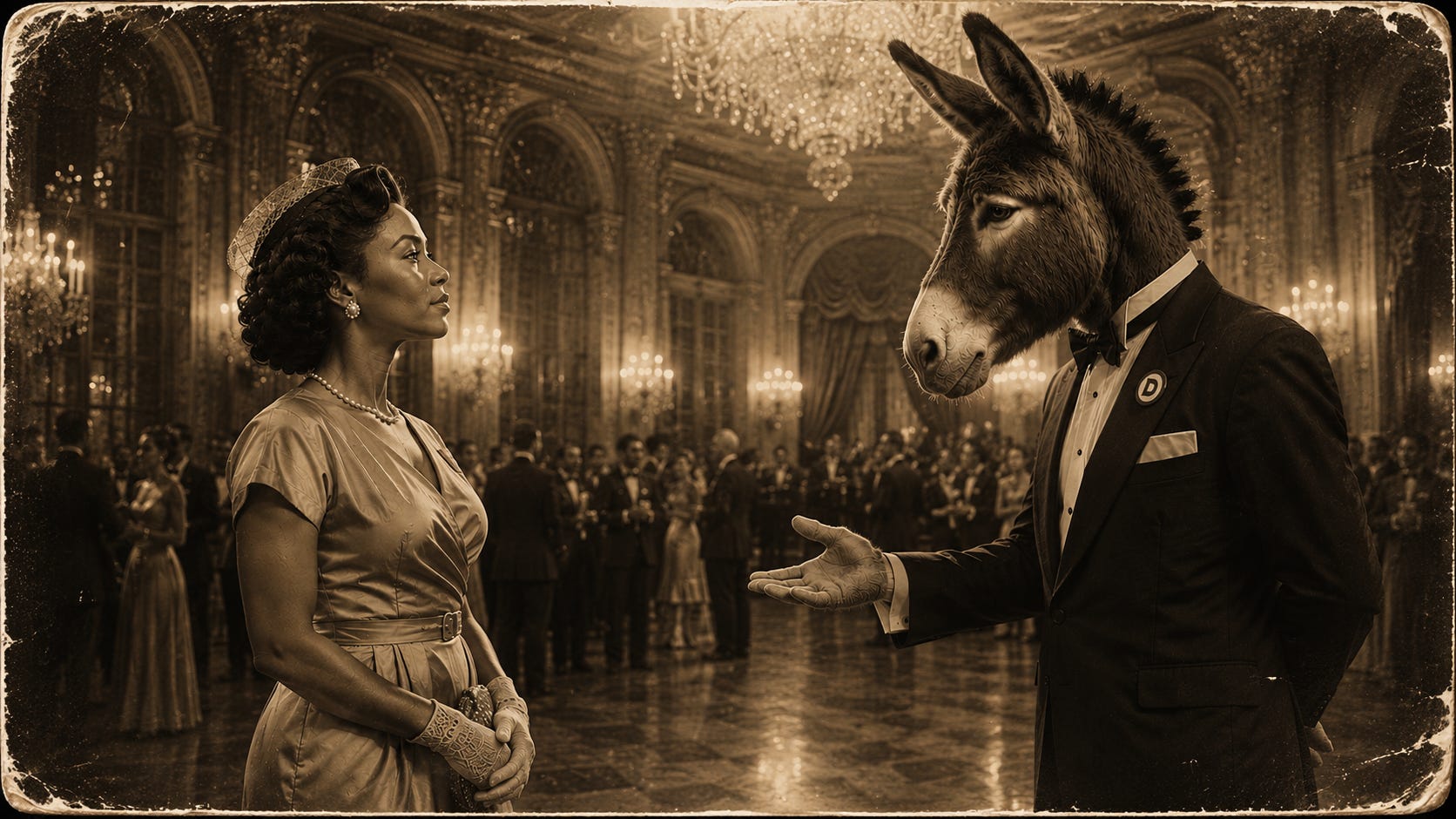
INTRO: First off, this is a A Juneteenth Meditation, that’s all!
Every Juneteenth, I find myself thinking about why we danced with a democrat and our citizenship.
Not the legal kind. Not the citizenship granted by documents, court rulings, constitutional amendments, or government proclamations.
I mean the deeper kind. The kind that lives inside a people.
White folks business isn’t finished, only separated by political lines, not via North and South, but by way of how they conserve power. Here’s to why we dance...
Dancing with a Democrat
Because America itself has always felt like a ballroom.
Magnificent. Ornate. Expensive. Beautiful from a distance.
For many Americans, the ballroom is a place of celebration. For Black Americans, it has often been a place of negotiation.
The story begins on Juneteenth a ballroom grandstanding party.
Or perhaps more accurately, the story begins when a newly freed Black woman receives an invitation.
Not an invitation to work.
Not an invitation to serve.
Not an invitation to observe.
An invitation to dance.
The ballroom was already crowded when she arrived.
That fact would bother her for years.
Not because she expected to be first. She understood history too well for that. What troubled her was the realization that the party had been underway long before anyone thought to tell her she was invited.
The room glowed with the confidence of old money and older traditions. Crystal chandeliers floated above polished floors. Gold trim climbed the walls. Musicians occupied a raised platform beneath an enormous mural depicting liberty, prosperity, and progress. Everywhere she looked, people danced.
Some danced awkwardly, some danced beautifully.
She stood in the doorway for several moments, absorbing the scene.
Freedom, she discovered, looked surprisingly expensive. The invitation had arrived late. Generations late, yet there it was folded neatly in her hand.
A simple card informing her that she was now welcome to participate in the grand American dance. The irony was difficult to ignore.
Her family had spent generations helping build portions of the ballroom itself. Their labor had polished the floors. Their hands had raised walls. Their sweat had contributed to the wealth that financed the celebration. Yet now, standing at the entrance, she felt less like an owner and more like a guest arriving after dessert.
Still, she refused bitterness, bitterness was heavy.
Freedom felt lighter. She adjusted her gloves, lifted her chin, and entered.
The orchestra struck a bright hopeful note.
Somewhere in the distance a trumpet announced possibility for perhaps the first time in her life, she allowed herself to imagine a future unconstrained by the past.
Not a perfect future, just a normal one.
A family, a home. A chance.
Most people underestimate how powerful hope can be.
Hope can survive chains. Hope can survive humiliation.
Hope can survive laws specifically designed to extinguish it.
That was the remarkable thing about Black Americans.
Every generation inherited disappointment. Yet every generation somehow smuggled hope into the next one. The woman carried that hope with her as she crossed the ballroom.
She did not come searching for power or revenge.
She came searching for belonging.
Belonging is perhaps the most human desire in existence.
To be invited into the center of the room rather than tolerated at its edges.
As she approached the dance floor, she noticed a figure moving toward her.
The crowd seemed to part naturally. He was dressed in blue.
Impeccably dressed.
His face, curiously enough, belonged to a donkey.
Not an ordinary donkey. A sophisticated donkey, a charming donkey.
The sort of donkey who had mastered the language of empathy.
The sort of donkey who always knew precisely what to say.
He bowed, just enough. Just enough to signal respect. Just enough to suggest partnership.
“My dear,” he said warmly, “I’ve been hoping we might finally meet.”
The statement struck her like music, finally!
What a beautiful word, finally implied she mattered.
For generations her people had lived outside the ballroom looking in. The possibility that someone inside had been waiting for them felt almost miraculous.
The donkey extended his hand, she accepted.
Their first dance was lovely.
History often becomes distorted by hindsight. People forget how much genuine hope existed at the beginning. They forget how intoxicating possibility can be.
The donkey listened. The donkey smiled.
The donkey spoke passionately about fairness, inclusion, progress, and opportunity.
He spoke as though tomorrow belonged to both of them and she believed him.
Not because she was naïve, because she wanted to.
The years passed. The dances continued.
Sometimes the donkey led gracefully.
Sometimes he stumbled. Occasionally he stepped on her toes.
When he did, he apologized, at least most of the time.
That mattered.
Across the ballroom stood another dancer dressed in red. She noticed the red dancer rarely apologized for anything. He often questioned whether she belonged in the room at all. So whenever the donkey in blue stumbled, she compared him to the dancer in red and concluded that things could be worse.
And often they could. That became the pattern.
A complicated relationship sustained by comparison.
The donkey in blue was never quite what she hoped, but he was rarely as frightening as the alternative.
And so the decades rolled by. The woman grew older.
Her children inherited the dance, then her grandchildren.
Entire generations entered the ballroom believing they were beginning a new chapter only to discover they had inherited unfinished dances.
Each generation loved the donkey a little more, each generation resented him a little more. Each generation defended him, and each generation criticized him.
Yet somehow the choreography remained remarkably familiar. The donkey always seemed most attentive when he needed a dance partner. Most affectionate when the ballroom grew competitive.
Most committed when another dancer threatened to take his place. The pattern repeated so often that eventually it became tradition.
And traditions possess extraordinary power, not because they are wise, because they are familiar. Whenever these concerns are raised, someone inevitably asks why she continued dancing with the one dressed in blue.
Why not choose the one dressed in red?
It is a fair question, but the distinction is not as complicated as people imagine.
The blue dancer may step on your toes, the blue dancer may become complacent.
The blue dancer may mistake loyalty for satisfaction. But the blue dancer still recognizes there is a dance.
The red dancer presents a different problem. The red dancer does not really wish to dance with her. The red dancer wishes to dance before her. Around her. Her role is not partner. Her role is to be an audience, decoration, witness and evidence.
An extra hired to fill the ballroom so the room appears more welcoming than it actually is.
The blue dancer occasionally forgets she is a partner. The red dancer occasionally forgets she is in the dance at all. One leaves her frustrated. The other leaves her invisible.
Yet eventually she realized something even more unsettling, tThe problem was not entirely the donkey, the problem was the choreography. The assumptions beneath the movement.
The music changed. The room changed. The generations changed.
Yet the dance somehow remained the same, and perhaps that is where the deepest disappointment lived. Not in betrayal, but in repetition.
One evening, long after the orchestra had begun playing familiar songs, she stood beneath the chandeliers and thought about every dance.
The beautiful ones.
The awkward ones.
The hopeful ones.
The disappointing ones.
The nights she felt seen.
The nights she felt invisible.
The nights she mistook attention for affection.
The nights she mistook movement for progress.
And suddenly a thought arrived that frightened her, what if I have confused dancing with justice?
The question struck harder than any insult, because the truth was complicated.
The music had been wonderful, the room had been magnificent. The invitations had felt validating, the victories had been real. The progress had been real.
Yet standing there beneath the fading light, she could not escape a deeper feeling.
She felt included.
But not embraced.
She felt as though she had participated in something intimate without ever becoming equal within it.
Then she understood. A hand extended toward you is not the same thing as a heart opened toward you. A willingness to dance is not the same thing as a willingness to share the room. And an invitation, no matter how beautifully written, isn’t freedom.
As the evening surrendered itself to midnight, she found herself lingering at the edge of the ballroom. For the first time all evening, she stopped looking at the dancers and began looking at the room itself.
It was magnificent.
The chandeliers seemed suspended from heaven itself.
Marble columns stretched toward painted ceilings.
The room possessed the kind of beauty that made people forgive things they otherwise would not. Standing there, she thought how strange it was that something so beautiful could leave a person feeling so lonely.
The ballroom reminded her of America. Grand. Ambitious. Magnificent.
A masterpiece from a distance.
Yet somehow haunted by the very hands that built it. She studied the architecture more carefully. Every line reached upward.
Every structure seemed designed to dominate space rather than welcome people into it. She wondered why men built things this way. Why power always seemed determined to rise rather than embrace.
Why grandeur so often came at the expense of warmth. The room was beautiful.
But it was beautiful in the way a cathedral can be beautiful to someone left standing outside. The donkey approached quietly.
Polite.
Thoughtful.
Kind.
Even now she could not honestly call him cruel, cruelty would have simplified everything. Instead he remained what he had always been.
Well-intentioned.
Flawed and Comfortable.
Outside, a taxi waited.
The donkey opened the door and offered his hand. One final courtesy.
One final dance step performed without music. As she settled into the back seat, they locked eyes. No promises. No anger.
No resolution.
Just recognition, the door closed. The taxi pulled away, ballroom and all receded into the distance. Its lights grew smaller and smaller until they resembled stars disappearing into the midnight.
She reached into her purse and unfolded the invitation, she imagined the conversation waiting for her at home. Someone would eventually ask the inevitable question.
Would things have been different had you danced with the one dressed in red?
She laughed softly to herself.
The question felt older than she was.
Then her eyes settled upon a line she had somehow missed before, printed neatly across the bottom of the invitation were the words:
Roses are red and violets are blue, come and choose the kinder of the two.
She stared at the sentence for a long time. Long enough to understand its sadness.
Long enough to understand its honesty. Long enough to understand that the invitation had never made any promises.
Only kindness, and kindness, she realized, was not what was wanted for herself or for her people.
Justice asks what is owed.
Kindness asks what is possible.
Justice changes structures.
Kindness merely dresses them.
The taxi continued through the sleeping city, the invitation rested quietly in her hands.
Finally she folded it, placed it back inside her purse, and looked out the window.
If anyone asked her tomorrow why she chose the partner she did, she would not argue.
She would not explain, she would not defend herself.
She would simply smile and say,
“I just prefer violets.”
This was geniously written! It is so true, and yes, each generation chooses the blue, and others choose the red. I so feel this, "I just prefer violets." Will anything ever change?